

Greetings, here’s another AI-generated podcast based on four of my posts. It does offer some up some important points from my research, but please note that my posts are much more detailed and with lots of helpful information, if I may say so myself.
Here they are (the links will open in new tabs):
10+1 Reasons Why I like Intermittent Fasting
Foods That May Lower Cholesterol. Some May Also Help with Fatty Liver
Plants and Herbal Teas That May Lower High Cholesterol and Help Improve Liver Health (Part 1)
Plants and Herbal Teas That May Lower High Cholesterol and Help Improve Liver Health (Part 2)
Disclaimer: I am not a medical or health practitioner, and no part of This Blog, or the articles, websites, and products I mention and link to on This Blog, is intended as professional medical or health advice, and should not be considered as such. Consult with your doctor(s) about starting any course of treatment, taking any supplements, or changing any (dietary, exercise, etc.) routines. Note that natural supplements and even some foods may interfere with certain medications. Also ask your doctor(s) about potential allergies you may have, including cross-reactive allergies. Some allergens can cause potentially fatal anaphylaxis. Here are my Full Terms and Conditions.
*
Henry: HappierHealthier.Blog — where the to-do list includes your liver, your blood pressure, your cortisol, and apparently your tea rotation. Mira has been busy.
Mara: She really has. Today we’re covering the metabolic and heart health case for intermittent fasting, a deep dive into herbal teas for cholesterol and liver support, and some grounded advice on relieving stress quickly. Let’s start with what fasting actually does to the body.
Fasting, Cholesterol, and the Heart
Henry: The premise here is that intermittent fasting is doing a lot more work than most people give it credit for — not just weight loss, but something that reaches into inflammation, blood pressure, even brain chemistry.
Mara: The post on intermittent fasting sets this up with a quote from neuroscientist Mark Mattson of Johns Hopkins: “from an evolutionary perspective, we are not made to snack all the time, as many of us do today. Our body needs a respite of several hours between meals.”
Henry: And when that respite disappears — when the liver, pancreas, and brain are running without a break — you get fatty liver, foggy thinking, and a metabolic profile that looks increasingly like trouble.
Mara: The blood pressure piece reinforces this from another angle. After three weeks of intermittent fasting, systolic blood pressure dropped by up to ten points. The post on monitoring blood pressure correctly adds useful practical detail — arm at heart level, same time each day, two readings two minutes apart — because how you measure matters as much as what you’re trying to change. And the foods post makes the diet side concrete: prunes, citrus, walnuts, fermented foods, olive oil, spices like ginger and turmeric, all with evidence behind them.
Henry: Which is a long grocery list, but a more appealing prescription than most.
Mara: The herbal side of that prescription gets its own treatment — and it goes considerably deeper.
Plants, Teas, and the Liver
Henry: The question here is whether herbal teas can do real work on cholesterol and fatty liver, or whether this is the wellness equivalent of wishful thinking.
Mara: The answer, with caveats, is that several plants have solid study backing. The Part 2 post puts it plainly: “supplemental sea buckthorn significantly improved the lipid profile in subjects with NAFLD or hyperlipidemia but had no such effect in healthy subjects.”
Henry: So it’s targeted medicine, not a general tonic — which is actually a more credible claim.
Mara: That’s the pattern across the full series. Part 1 walks through the infusion plants — chicory, dandelion, lemon balm, roselle, thyme — each with cited studies and a clear note on side effects and drug interactions. Dandelion, for instance, outperformed silymarin on liver fibrosis markers in one rat study. Roselle lowers blood pressure enough that it can interact dangerously with medication for it. The introductory piece frames the whole series: these are scientifically reviewed plants, not folklore, but they are also not playthings.
Mara: Part 2 continues with the decoction plants — chicory root, astragalus, ginger, burdock, elecampane, rose hips, sea buckthorn — and adds bitter melon as a late entry. Rose hips stand out: forty grams of rosehip powder daily for six weeks significantly lowered total cholesterol, LDL, and systolic blood pressure in one study on obese individuals.
Henry: Thirty herbal teas in rotation is either a very committed protocol or a very full cupboard. [NB: Taken out of context. In my piece, I said I used thirty herbal teas in rotation, in general. For liver health, I have given in my posts six plants for infusions and eight plants for decoctions.]
Mara: Probably both. The consistent message is to work with a doctor, rotate plants every few weeks, and treat concentrated supplements with more suspicion than the teas themselves. From inflammation to stress, the body’s signals keep pointing the same direction.
Quick Moves for a Stressed-Out Day
Henry: The stress post is less a clinical review and more a real-time dispatch — written while baking vegetables and dancing through a movie, which is either chaotic or extremely on-brand.
Mara: It is genuinely practical. The core advice: “Don’t expect the stress to diminish on its own. It might, but then it may not.” Take positive action early — healthy food, movement, tackling small tasks, getting outside.
Henry: Dancing while watching a film keeps coming up as a specific recommendation, and honestly, the bar for entry is low enough that it might actually work.
Mara: The post also flags forest bathing — even a park walk among trees reduces cortisol, heart rate, and blood pressure through volatile compounds the trees release. Thirty minutes outside is framed as a meaningful intervention, not a luxury.
Henry: What ties all of this together is that the body keeps score — and fasting windows, tea blends, and a walk in the park are all ways of paying down the tab.
Mara: Small consistent choices, with real evidence behind them. That’s the thread. More of it next time.
*
Thank you for your visit!
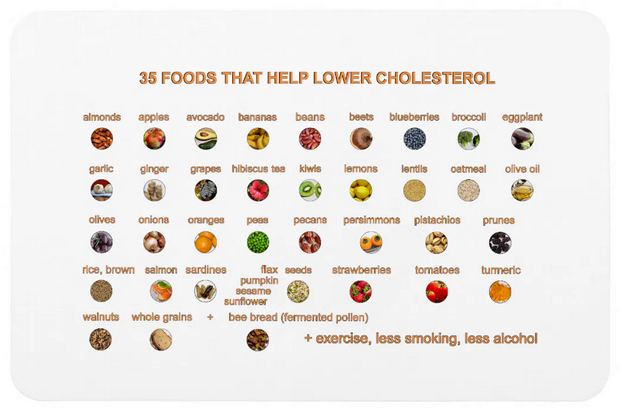
Here are some products I have created with foods that may help lower cholesterol.
Disclosure: This blog post contains some affiliate links. If you click on (any of) them and make a purchase, they generate revenue for this blog (at no extra cost to you!). I am a Zazzle Associate and designer, and I earn commissions when you buy products through my referral links. All affiliate links on this blog are identified as such. Here’s my Full Disclosure.
Please note that the writing is much crisper on the actual products. Just click on the images to see them on Zazzle.


Mug for Righties (affiliate image link)

and smoke and drink less. Mug for lefties (affiliate image link)

Hard plastic beverage coaster with a cork back (affiliate image link)
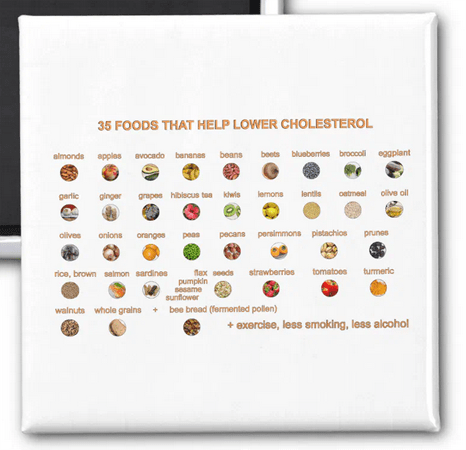
less smoking, and less alcohol. Magnet (affiliate image link)

along with exercise, less smoking, and less alcohol. Natural ways to reduce cholesterol
(affiliate image link)
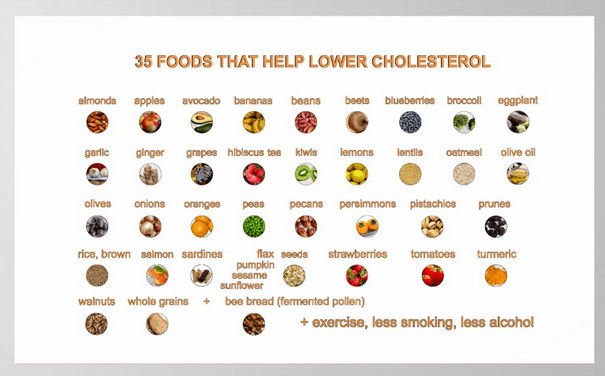
along with exercise, less smoking, and less alcohol. Poster (affiliate image link)
I’ll be back with some more info on foods that may reduce blood pressure naturally, but for now, here are some products I have customized with a graphic design based on researching 30 Foods for mild hypertension.
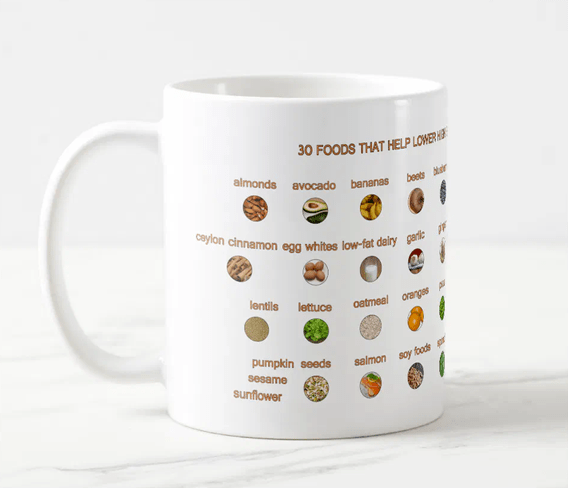
along with exercise and other healthy habits. Mug for lefties (affiliate image link)
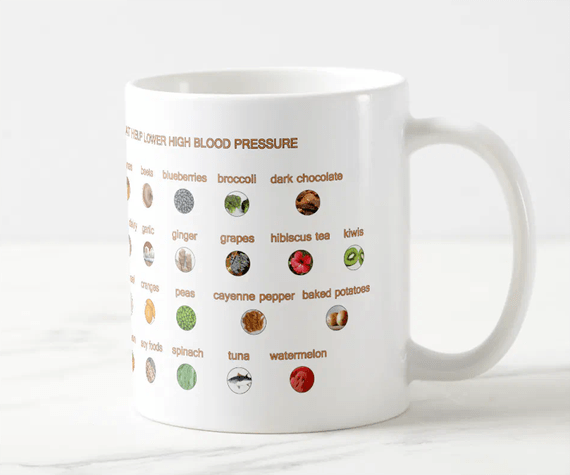
including exercise that’s right for you. Mug for righties (affiliate image link)
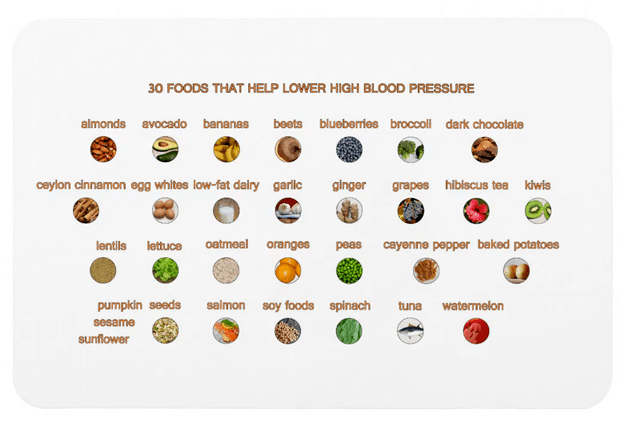
As always, pins and shares are much appreciated!
To a happier, healthier life,
Mira

