

Chef Alain Braux’s (sometimes wrong) advice is a good start for further research
Article originally posted in Middle-Pause on Medium on August 13, 2026
I’m struggling with high cholesterol, partly because of approaching menopause, partly because of not enough exercise, and, I believe, mainly because of stress.
As for the other element in the equation, food, I’ve learned lots over the years and put most of it into practice. One of the books that taught me about cholesterol and food was Chef Alain Braux’s How to Lower Your Cholesterol with French Gourmet Food.
Disclaimer: The information in this article, Chef Braux’s book, and the web pages I link to is intended for general informational and educational purposes only — not as medical advice. Consult with your doctor(s) about starting any course of treatment, taking any supplements, or changing any (dietary, exercise, etc.) routines.
Chef Braux, who lives in Austin, Texas, is a chef and nutritherapist. He designs custom meals for people with allergies and provides nutritional advice to those who want to address certain health issues without supplements.
I learned a lot from Chef Braux’s investigations into what raises and lowers our cholesterol, but upon doing my own research based on his claims, I found that some of the latter do not bear out. One of his more egregious statements is that one gram of garlic a day can reduce plaque by up to 82%!
Still, the book is good as a starting point for a discussion about cholesterol, and it includes some surprising tidbits besides the obvious ones, such as sugar, trans fats, and fried foods affecting cholesterol and triglyceride levels and causing inflammation in the body. That much I knew.
Before he started on his journey of lowering his own cholesterol and triglycerides, Chef Braux had 240 total cholesterol, with 167 LDL-C and 52 HDL-C, and 105 triglycerides. After one year, his results were as follows: 205 total cholesterol, 143 LDL-C, 49 HDL-C (not a good result, this one), and 67 triglycerides.
Here’s some of his good advice.
But first, a word about statins
I’ve kept avoiding statins for two reasons. One was because a nutritionist told me a long time ago that I shouldn’t worry about cholesterol as long as I have estrogen. It was a bad piece of advice, but I did become complacent, despite also having fatty liver disease, which is not a good way to treat one’s liver and one’s body.
The second reason was that I’d heard from someone that statins made her muscles ache, in addition to other negative side effects, and then I read in Chef Braux’s book that they can also lead to severe damage to the liver and the kidneys, among other things, which also include a foggy brain. I now doubt the side effects can be that bad, though I don’t really know. My mother, for instance, takes a low dose of statins and she feels fine, having no side effects.
But, of course, Chef Braux would be motivated to take such a negative view of statins, given his training and career as a nutritherapist.
As a side note, there is such a thing as familial hypercholesterolemia, where food and exercise can’t help much and the affected persons do need to take statins if they want to avoid cardiovascular issues — because, again, nothing else works.
A comment on weight loss, too
Another drawback of Chef Braux’s advice is that he focuses too much on food at the expense of the importance of more rigorous exercise and weight loss. His recipe of twenty minutes of leisurely walking per day and one class of dancing a week is not enough for me, a woman approaching fifty and fighting the impact of lower estrogen.
As for weight loss, when I had my most recent abdominal ultrasound, the doctor told me that losing 20 kilos was the best idea in my case. She said that people who lose weight after bariatric surgery come to her with great bloodwork results. I happen to know that for some people weight loss is not the answer to high cholesterol, but I’ll try to lose at least 10 kilos in the next year. I’m lucky that I still can lose weight with exercise, despite perimenopause, so now I’m focused on that.
But there was a time when I learned good things about eating healthy too. And I did have some success. One year, after eating lots of avocado along with other healthy foods on a weekly basis, I got my triglycerides within the normal range.
Then I became complacent again for a while, until perimenopause came and had me worry about all this once again.
So please consult with your doctors if you have high cholesterol and triglycerides.
Lowering your cholesterol (and triglycerides) with food
Let me show you some examples of how Chef Braux advises us to achieve a healthier lipid balance with food, where he is wrong, and what further research yields. And I say food, not French gourmet food, because there isn’t much fancy food in the book, but rather some simple (and, again, sometimes wrong) health advice and recipes.
So firstly, it can help to reduce the ingestion of cafestol, since this compound blocks the liver from removing LDL-C from your blood. The more unfiltered your coffee is, the more cafestol it contains. Turkish and French press coffee are the worst. A coffee maker with paper filters is the best.
An espresso machine is not too bad, but still, it does raise cholesterol 2 to 3 mg/dL per each cup, and each mg matters when it comes to trying to lower cholesterol naturally. I’ll probably have to resort to more green and black tea instead, since I like their taste and health benefits anyway.
Secondly, while it may be a good idea to eat many vegetables and fruit raw, as he says, there’s also value in steaming vegetables, because carotenoids — beta-carotene, lycopene, lutein, and others — are locked inside plant cell walls. Steaming vegetables increases the bioavailability of carotenoids.
Thirdly, agave nectar works well as a healthy sweetener, since it has a low glycemic index and also dissolves easily in cold drinks. The GI of agave nectar is less than 30.
Fourthly, seed oils can help improve your lipid balance.
Seed oils contain linoleic acid, which can be transformed in the body in gamma-linolenic acid (GLA) with the help of the delta-6-desaturase (D6D) enzyme. GLA is a highly anti-inflammatory compound that lowers triglycerides, TC, and LDL-C, and may raise HDL, “good,” cholesterol.
Chef Braux mentions GLA but not the D6D enzyme, and it’s essential to extend the discussion that way, because this enzyme is susceptible to nutritional deficiencies and needs various vitamins and minerals to work properly. It’s also sensitive to diabetes, allergies, alcohol, smoking, psychological stress, and other factors, including trans fats.
Pumpkin seed oil, which I took for a while, helps the formation of GLA through its content of mineral cofactors for the D6D enzyme, such as zinc and magnesium. It’s probably time to buy another batch.
Please note, however, that seed oils, including borage oil, can be very dangerous, especially to pregnant women — causing birth defects, among others — but not only to them. Borage oil can also be severely toxic for the liver, among other awful negative side effects.
As I mentioned, I don’t always side with Chef Braux’s opinions. But that’s what books are for, to stimulate research and further discussion. He is very partial, for instance, to raw butter, but raw butter can also be very dangerous, carrying the risk of contamination with bacteria such as Salmonella and E. coli, among others.
He also holds that coconut oil can help the thyroid be more active, which can then lead to weight loss — an assertion that is not borne out by scientific studies on humans. He also mentions a study on populations from the Pukapuka and Tokelau islands, where people ate a lot of coconut oil, meat, and milk, and where cardiovascular disease was uncommon. The reality is more complicated. They also ate a lot of fiber and did plenty of exercise, and they consumed a diet very low in processed carbs.
Contrary to what Chef Braux states, coconut oil does, in fact, raise TC and LDL-C.
But yes, sixth, coconut oil does (significantly) increase “good,” HDL-C.
It’s also a good source of the parent triglyceride for lauric acid, similarly to human breast milk. In the body, the pancreatic lipase releases lauric acid and monolaurin from this triglyceride. These two compounds, and especially monolaurin, are very powerful against bacteria.
One article published in Nature in July 2025 shows that monolaurin can fight even antibiotic-resistant Staphylococcus aureus in some cases. It can also neutralize viruses and be effective against Candida albicans — which is why, instead of an antifungal pill for yeast infections (bound to happen when you have a sweet tooth), I’ve successfully taken a supplement with extract of coconut powder in it for a while now, as needed.
Here’s a 2020 review article about the antimicrobial benefits of monolaurin as a supplement rather than a nutrient.
Seventh, extra virgin olive oil (EVOO), which is high in polyphenols and oleic acid, an omega-9 monounsaturated fatty acid, helps not only reduce cholesterol and its oxidation (and increase HDL-C), but also helps prevent colon cancer and osteoporosis, among its many health benefits, as Chef Braux mentions in his book.
Indeed, studies show that EVOO suppresses cancerous tumor formation in the colon through three mechanisms: by upregulating a tumor-suppressing gene, by blocking the survival and disrupting the multiplying pathways of colon cancer cells, and by boosting the health of the gut microbiome.
EVOO is an important part of the Mediterranean diet, and supplementing more of it to such a healthy diet can lower the risk of major cardiovascular events by 30%, compared to people on a low-fat diet, as shown by the PREDIMED Trial. This study was conducted in Spain on 7,447 participants aged 55–80 who had high cardiovascular risk but no cardiovascular disease. It had a 4.8-year median follow-up and was reported in the New England Journal of Medicine in 2013.
As for osteoporosis, a study building on this famous PREDIMED Trial showed that over a median follow-up of 8.9 years, participants had their risk of bone fractures reduced by 51%.
Studies have also shown that EEVO makes stem cells turn into osteoblasts, while also driving mechanisms that stop bone tissues from decaying and losing calcium.
For these and other health benefits that impact women in particular, including the mechanisms that make EVOO a wonderful tool in preventing breast cancer, see “Protective Effects and Benefits of Olive Oil and Its Extracts on Women’s Health,” a 2021 comprehensive review published in the scientific journal Nutrients.
Eighthly, cassia cinnamon, which is great for improving insulin sensitivity, can also modestly improve cholesterol and triglyceride levels.
Ninthly, oatmeal really is that wonderful. A cup of cooked oatmeal per day can lower “bad,” LDL cholesterol by up to 10%. It works because of a simple but great mechanism. The beta-glucans — a kind of soluble fiber — in oatmeal binds to bile acids and helps remove them from the body. The liver then is forced to make more bile, and it does so by extracting LDL cholesterol from your blood.
Tenthly, an avocado a day works like a charm against cholesterol and triglycerides, when coupled to a moderate-fat diet. A 2015 study showed that it can lower LDL cholesterol by up to 13.5 mg/dL over a period of five weeks.
And that was all for this article. Again, take Chef Braux’s book with a grain of salt. It’s hyped up and severely wrong in some cases, but a good way to start research of your own in preparation for a conversation with your doctors.
Enjoy!
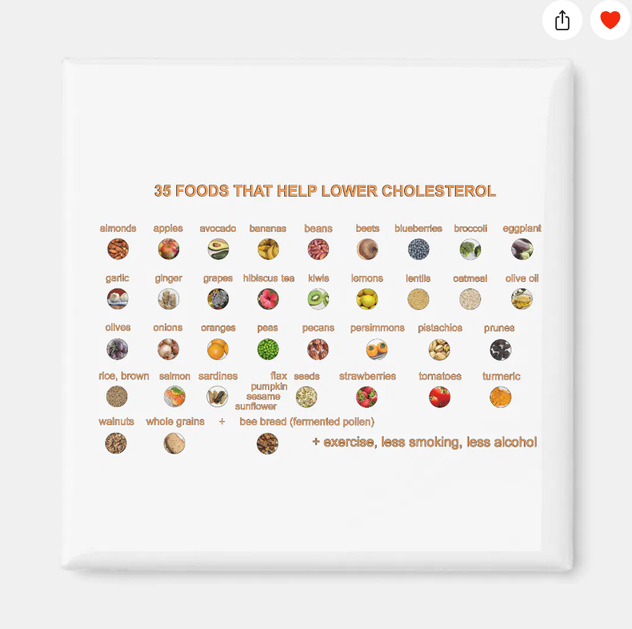
P.S. If you want to read more about how to lower your cholesterol with food, here’s a post that also includes links to my products with the design shown at the beginning of this article (“35 Foods That Help Lower Cholesterol”):
Foods That May Lower Cholesterol. Some May Also Help with Fatty Liver
P.P.S. I also have an article about lowering blood pressure naturally. This one is more than just about food (but it, too, includes a design I created, with “30 Foods That Help Lower High Blood Pressure”).
Natural Ways That May Help Lower High Blood Pressure
And here are some of my customizable Zazzle designs for the holiday season:
https://happierhealthier.blog/tag/christmas
Disclosure: This blog post contains some affiliate links. If you click on (any of) them and make a purchase, they generate revenue for this blog (at no extra cost to you!). I am also a Zazzle Associate and designer, and I earn commissions when you buy products through my referral links. All affiliate links on this blog are identified as such. Here’s my Full Disclosure.
Here’s a peek at some of those Christmas products:

on a golden background. With Rudolph the Reindeer
saying “Oh deer, what a YEAR,” 3 photos, and Christmas and New Year wishes
of peace, love, and joy (affiliate image link)

with Rudolph the Reindeer saying “Oh deer, what a YEAR!”
With 4 photos, snowflakes and stars,
and a long year-in-review letter on the back (affiliate image link)

and Rudolph the Reindeer saying “Oh deer, what a YEAR!”
With bells and holly, snowflakes and stars,
and a letter on the back (affiliate image link)

with Rudolph, Christmas baubles.
With snowflakes on a red and blue background (affiliate image link)

With snowflakes on a golden background (affiliate image link)

To a happier, healthier life,
Mira

