


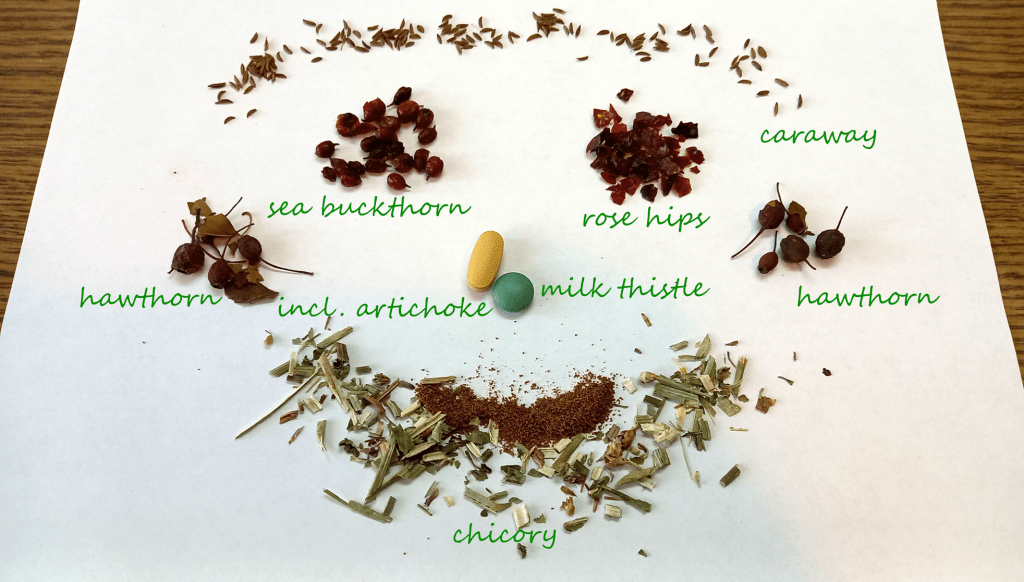
A review of a Reader’s Digest book, Nature’s Medicines: A Guide to Herbal Medicines and What They Can Do for You, supported by further scientific findings
Originally posted in The Road to Wellness on Medium on August 16, 2024
Part 3/3
Chicory (Cichorium intybus), Family Asteraceae
Chicory is very popular among some health-minded Romanians for the prebiotic properties of its main active compound, inulin, which is present in all the parts of this plant — roots, stems, leaves, and seeds — but the flowers, although it’s extracted from the root, which has 68% inulin by dry weight.
The root, roasted and ground, also makes for a tasty caffeine-free coffee substitute, as this book, too, acknowledges. This chicory drink, like the decoction (from root, leaves, and flowers), is a mild laxative that helps with digestion in more ways than one and also helps the health of the liver — and the kidneys, as I’m learning now chicory root is a diuretic too.
I’m also using the aerial parts — leaves and stems — in blended infusions to improve the health of my fatty liver and help lower my cholesterol.
Disclaimer: I am not a medical or health practitioner, and no part of This Blog, or the articles, websites, and products I mention and link to on This Blog, is intended as professional medical or health advice, and should not be considered as such. Consult with your doctor(s) about starting any course of treatment, taking any supplements, or changing any (dietary, exercise, etc.) routines. Note that natural supplements and even some foods may interfere with certain medications. Also ask your doctor(s) about potential allergies you may have, including cross-reactive allergies. Some allergens can cause potentially fatal anaphylaxis. Here are my Full Terms and Conditions.
As I mentioned, the book guides you with regard to which parts of a plant to harvest, when, and how to prepare the remedies. In this case, the leaves are harvested when the plant blooms and the roots should be harvested in September if you use them dry. You then chop them small and dry them in the sun before roasting them and grinding them.
These days, however, as the editors mention, we have instant chicory available. The latter sells great in Romania in health foods shops, so it’s very easy to enjoy a drink of chicory root every day. I also use the leaves and stems in blended tea infusions, but I prefer chicory coffee, which I take with soy milk and hot water, with or without some drops of stevia.
Chicory can help lower blood sugar as well, among other things. It also has anti-inflammatory properties that help with gout and rheumatism.
According to this book, chicory poultices have also been a common traditional remedy.
Chicory has many more health benefits. A 2002 study found that an extract of chicory root can inhibit a certain type of carcinoma in mice. Further research confirmed these anti-tumor, antioxidant properties. For a detailed account of current research, see Chicory: Understanding the Effects and Effectors of This Functional Food on PubMed Central.
Precautions listed. If you have inflammation in the intestines or, even worse, a blockage of the intestines, refer to a medical professional before using chicory remedies.
For more Precautions, see WebMD. They warn against using it while pregnant and breastfeeding, though it’s not clear what amounts they’re referring to. Nevertheless, when pregnant and breastfeeding it’s best to have a list of safe foods from your doctor(s) and go with those.
Among the other things on WebMD: Don’t use if you have gallstones, and be careful if you have blood sugar problems since chicory may lower glucose levels. Also, stop using it two weeks prior to surgery.
I’m including these extra Precautions with each plant to encourage you to always keep looking for these warnings regarding herbs, even if you have a good book on natural remedies and their medicinal uses like this one. WebMD is one of the best places on the net to look for these Precautions. They also give an overview, along with some ideas for the uses, side effects, drug interactions, and dosing of various herbs, though those, including their section on drug interactions, are often lacking, so always check with your doctor(s).
Dog Rose (Rosa canina), Family Rosaceae
The dog rose is a wild shrub, mostly prized for its fruit, called rose hips.
I was walking around the city one day when I spotted an older woman selling rose hips in bags of one kilo. It seemed like way too much for someone to buy a kilo because you don’t want them to get moldy, for instance, and then you may want to use other herbs as well in your teas, not just rose hips.
But it turns out rose hips are, indeed, some of the best berries you could use in a decoction. The old lady told me they were good for “blood pressure, cholesterol, and liver health.” Guess what? They’re good for all that and then some!
They are a great source of antioxidants, among them vitamin C; malic and citric acids; carotenoids and anthocyanins; tannins; flavonoids, including catechins and quercetin; phenolic acids, and other phenolic compounds. As such, they’re a great tonic for the immune system.
The editors list dog rose mainly as a good remedy for colds, the flu, and fatigue and that it has also been shown to help with arthritis — osteoarthritis and rheumatoid arthritis—, among other health benefits. The latter is not surprising, given the anti-inflammatory properties of the fruit, but it appears that a particular anti-inflammatory compound, a galactolipid with a specific function, is responsible for improving these arthritic conditions.
Besides helping with blood pressure, cholesterol, and liver health, rosehip powder may also help lower blood sugar, so beware of interactions with medications for diabetes, blood pressure, and other drugs.
Extract from rose hips has also been proven to be more potent than other natural remedies in helping to fight against cancer cells. Even if sometimes they have only antiproliferative effects without promoting apoptosis (death of [cancer] cells), they demonstrate anticancer activity in colon, triple-negative breast cancer, and other malignant tumors.
Some scientists seem to cautiously suggest that rose hip extracts might be a beneficial addition to conventional cancer therapy. That is not to say that this is the case with rose hips or that this may also be the case with other potentially helpful herbs as well. Often, herbs impair the effects of conventional drugs — including those used in chemotherapy — or interfere dangerously with them.
Precautions listed. Do not use rose hips when pregnant or breastfeeding. For more precautions, see WebMD here and here and talk to your doctors regarding rose hips and all medicinal herbs.
Rose hips have been found dangerous in high doses, as they can lead to blood clots, among other things, or in supplement form in general, since you can get kidney stones, for instance. They also interact with medications and are not good for you if you have certain illnesses, including sickle cell disease.
A Few Words of Warning about Rose Hips and All Medicinal Herbs
Some cancer studies on rose hips, including one about their cytotoxic effect in colon cancer, got some scientists excited about the possibility of a daily tablet with an extract from this fruit reducing the risk of certain such illnesses, but, despite the common use of herbal extracts in vivo for 6 or 8 weeks, there is also scientific evidence pointing to the dangers of natural supplements. Concentrated phytonutrients — often 50 times more concentrated than in the actual foodstuff we would ingest in a day — can lead to liver damage and even liver failure in a matter of months, and too many antioxidants can also turn the tables around and lead to cancers instead of preventing them.
Hawthorn (Crataegus laevigata, Crataegus monogyna), Family Rosaceae
I didn’t want to include this plant initially because it may tempt some to use it instead of proper medical treatment for various heart problems. It had been used like that traditionally before there were allopathic remedies available (such as drugs and surgery), but these days heart doctors save many lives, so make sure you see a cardiologist and other specialists if you have cardiovascular problems.
One of my aunts, who has been treating a heart condition with hawthorn, is now experiencing weakness and fatigue every afternoon, so all is not right with her heart.
That said, hawthorn can help a lot if you want to help prevent a heart condition or if, like my mother, you’re taking an allopathic medicine for your heart and supplement it with hawthorn tinctures if it doesn’t interfere with your heart medication or other treatment.
According to this book, hawthorn fruit has been used since the Middle Ages for various heart conditions, including the health of arteries, high blood pressure, palpitations and tachyarrhythmias, a weak heart, and angina. Again, there are better ways to deal with all of that these days, but if one is relatively healthy, hawthorn remedies can often safely contribute to one’s effort to keep arteries healthy and lower blood pressure if the latter is only in the prehypertension range.
NB: Other species of hawthorn, including Crataegus pinnatifida and Crataegus chrysocarpa, have also been studied for their health benefits.
It’s important to keep in mind that the polyphenolic compounds in hawthorn berries benefit the heart and cardiovascular system in many ways, not just by increasing the elasticity of blood vessels and lowering blood pressure but also by reducing total and LDL cholesterol and, of course, fighting its oxidation, and helping with chronic inflammation.
A 2016 study on mice, for instance, showed that hawthorn berries, and especially their peel, also help reduce inflammation in the liver caused by a high-fructose diet.
Hawthorn can also function as a sleep remedy in the case of minor sleep disturbances, and, indeed, it’s included in many natural combinations along with valerian, as this book says. Recent research has also found hawthorn extract useful in combination with magnesium and an extract from California poppy for mild-to-moderate anxiety.
Hawthorn is also used as a digestive aid and for its effects against premature skin aging.
The editors mention that for a while, only the fruit was used as a natural remedy but that the flowers are medicinal, too, containing aromatic amines, flavonoids, and other antioxidants that have health benefits for blood vessels and the heart.
Recent research, however, has shown that the leaves have health benefits too. A study on mice found that vitexin, a flavone in hawthorn leaves, helps reduce neutrophils (white blood cells that respond to infection, inflammation, and stress) and proinflammatory cytokines (signaling proteins involved in inflammatory and immune responses).
I use the berries and leaves in herbal tea blends, both in infusions and decoctions, and my mother uses hawthorn tincture my aunt makes with fresh flowers and leaves. And when the berries come around, my aunt dries them for tea infusions.
Precautions listed. Hawthorn can be used as a long-term preventive remedy. Don’t try to treat cardiac conditions with hawthorn without your doctor’s advice.
High doses of hawthorn can cause dizziness. Do not drive after using hawthorn.
For more Precautions, see WebMD. Keep in mind that hawthorn can interact with many heart medications as well as other drugs as well. Don’t use hawthorn if you’re pregnant or breastfeeding.
I could include more plants, but what I most wanted to do in this piece was to give you an idea of the value of books such as this one. It may not be up to date with the latest research, but it’s certainly a good starting point.
You could keep this plant book or a similar one as a reference for various health conditions, and when you do, indeed, want to use some of the info in it, you could look up more research online, as well as an extended list of precautions, and then, thus prepared, could make appointments to have deeper discussions with your family doctor and other medical specialists.
Thank you for reading!
P.S. Two Important Notes About the Authority of the Info in This Book
Nature’s Medicines is based on The Herb Book, by John B. Lust, published at Benedict Lust Publications in New York in 1974, as well as on 15 other highly-regarded volumes published between 1993 and 2003, including The Encyclopedia of Medicinal Plants by Andrew Chevallier published by Dorling Kindersley (DK) in 1996, The Royal Horticultural Society New Encyclopedia of Herbs and Their Uses by Deni Brown, also published by DK (2nd edition, 2003), and Major Herbs of Ayurveda by Elizabeth M. Williamson, ed., published by Churchill Livingstone in 2002.
The current volume lists as scientific consultant John Wilkinson, BSc, PhD, DIC (Diploma of the Imperial College London for postgraduate research work), and member of the Royal Society of Chemistry, Senior lecturer in phytochemistry and pharmacognosy at Middlesex University in London, and as a medical consultant, Dr. Andrew Dunford, MSc, MRCGP (General Practitioner), and member of the (British) National Institute of Medical Herbalists.
*
I hope you’ve enjoyed today’s post. Here are Part 1 and Part 2 if you missed them.
To a happier, healthier life,
Mira
 HappierHealthier.Blog