


A review of a Reader’s Digest book, Nature’s Medicines: A Guide to Herbal Medicines and What They Can Do for You, supported by further scientific findings
Originally posted in The Road to Wellness on Medium on August 16, 2024
Part 1/3
(Here’s Part 2/3)
The Romanian Reader’s Digest Publishing House was popular for a while after its debut in 2004, with salespeople nicely but determinedly marketing their latest books over the phone, and then fizzled out. Now, only a website remains, where they sell some of the few copies they have left, and where they list their many other titles as out of stock.
It’s a shame, because their books are quite useful. Today, I’m reviewing one of them, the Romanian edition of Nature’s Medicines. A Guide to Herbal Medicines and What They Can Do for You, a nicely put-together hardback volume based on some of the best scientific-based books on medicinal plants out there — 16 of them!
Nature’s Medicines — “Farmacia naturii” in Romanian — was published in Bucharest in 2007 (based on the 2003 London edition), and my mother acquired it the same year. Not that she read it. If she needs tinctures — of hawthorn, for instance, a heart tonic — she asks her sister to make them. My aunt has always read books on nature remedies and, in time, has become adept at making some of them and administering others. We joke that she should have become a GP instead of a high school teacher. That said, these days, she’s not doing too well, and she should have seen a GP for her heart condition a long time ago. That should not discourage you, however, from exploring these plants. There’s a way to have the best of both worlds sometimes — both allopathic, mainstream medicine, and natural remedies.
Disclaimer: I am not a medical or health practitioner, and no part of This Blog, or the articles, websites, and products I mention and link to on This Blog, is intended as professional medical or health advice, and should not be considered as such. Consult with your doctor(s) about starting any course of treatment, taking any supplements, or changing any (dietary, exercise, etc.) routines. Note that natural supplements and even some foods may interfere with certain medications. Also ask your doctor(s) about potential allergies you may have, including cross-reactive allergies. Some allergens can cause potentially fatal anaphylaxis. Here are my Full Terms and Conditions.
The book is beautifully laid out and illustrated, with one plant per page. Each plant comes with its Romanian and its (Latin) botanical name, along with the name of its family of plants, and is briefly described in four lines. Then, we’re given advice on when to harvest the Useful Parts of the plant, followed by notes on its Active Compounds, Medical Uses, and Cultivation. We get a scientific botanical drawing (or photo, in some cases) along with a photo of dried parts, as I mentioned. There’s also a tiny photo of the plant in the upper-left corner of the page. Finally, the third bottom of the page is devoted to Preparation and Dosage, along with Precautions.
The info is geared toward how you can use the plant rather than how to cultivate it, and it somehow manages to include historical background, too. It’s actually quite amazing how much the editors fit into this format, although I’m often left hungering for much more. Nevertheless, with presentations on over 200 plants and their health benefits for over 150 conditions, this is definitely a good compendium.
Accompanying this info, there’s a very interesting small section at the beginning of the book about some of the long history of using plants as medicines, along with indications on how to grow, harvest, and preserve these herbs.
Attention is also given to how to prepare the remedies, be they infusions, decoctions, compresses, decoctions, syrups, tinctures, poultices, massage oils, or preparations for inhalations.
Since I cannot comment on all the medicinal plants in this book, I’ve made a selection based on some of the most common herbs that have been used traditionally in Romania. Many of these herbs are harvested here as well, both by producers who distribute them to health food shops and by older and younger people who grew up in the countryside and continue to live there or return there at regular intervals.
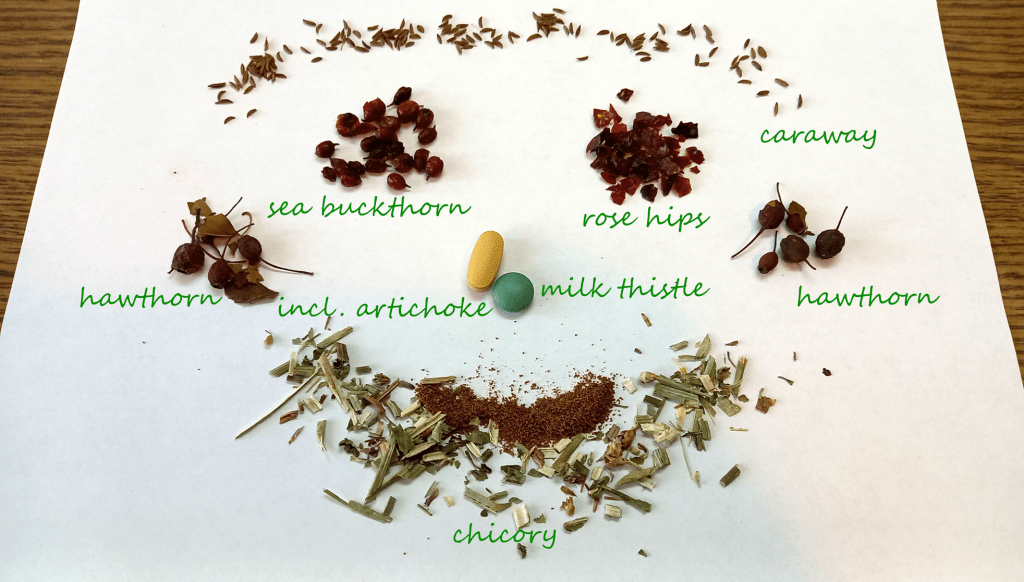
I’ll discuss artichoke, milk thistle, sea buckthorn, caraway, chicory, dog rose (rose hips), and hawthorn.
Artichoke (Cynara scolymus), Family Asteraceae
The leaves of the artichoke are rich in cynarin, which is a very common remedy in medicines for the liver, along with silymarin from milk thistle (Silybum marianum) — things I’ve known and wrote about when I researched natural remedies for the liver, especially as regards NAFLD (non-alcoholic fatty liver disease).
I’m learning now from this book that cynarin is not the only compound in artichoke that benefits the liver. Artichoke leaves contain a wealth of phytonutrients that help facilitate the secretion and flow of bile, which plays an important role in the catabolism of hepatic cholesterol, and artichoke extracts from these leaves can lower total cholesterol, LDL-C, and triglycerides. Such extracts have also been shown to help protect the liver from oxidative stress and to help promote liver cell regeneration.
I much prefer herbal teas to herbal supplements, as the latter can easily come in amounts toxic for the body (one man needed a liver transplant after two or three months of using green tea supplements), but I do take a few herbal supplements nevertheless.
Ideally, if I had the money and more time to spend in the kitchen, I would eat salmon, trout, and sardines seven times a week instead of taking omega-3 supplements, for instance, since you get vitamins, minerals, and protein too, which work synergistically with the healthy fats, but then fish may be contaminated with mercury, so, in the end, I’ve resigned myself to omega-3 supplements, taking fish only now and then.
The lesson remains, however, and it’s borne out by more and more recent studies, as you can see here with artichoke: it’s better to consume the whole package, not just an individual phytonutrient or another. The market has adapted quickly to these facts, and now we see extracts from various plants, not just the more popular ones.
Unfortunately, though, these extracts come at huge concentrations, which more often than not do more harm than good and, as I said, can even kill you. Artichoke extract, for instance, comes in doses of several hundreds of mg, which can’t be good. In comparison, the product I use, besides herbal teas, for my slightly raised cholesterol — and NAFLD — includes only 80 mg of artichoke extract.
There’s more to artichoke, including a role in reducing glucose levels — warning alert: it can become a problem if you have diabetes and take medication for it —, and its anti-inflammatory, prebiotic, and diuretic properties, among other things, not all of them mentioned in the book. One of these other health benefits — which can also become problematic — is that artichokes lower blood pressure, probably mainly on account of their potassium content.
Precautions listed in the book: Don’t use artichoke remedies if you have gallbladder stones. Don’t use it when breastfeeding, as it reduces the quantity of milk. It can cause allergies. (It belongs to the aster family, which includes daisies, ragweed, marigolds, and chrysanthemums, among many, many others.)
WebMD lists other Precautions and Side Effects, including gas, diarrhea, and other types of digestive distress, even as it lists artichoke extract as possibly effective for indigestion after taking an extract for 2 to 8 weeks. As always, talk to your doctor(s) before trying any new remedy.
Milk Thistle (Silybum marianum), Family Asteraceae
These days, silymarin, a complex mixture of silybin A, silybin B (which, in equal proportions, make up silibinin), and other phytonutrients in the seeds of milk thistle, is probably the most famous remedy for liver health. Besides its hepatoprotective effects, silymarin has antioxidant and anti-inflammatory properties, and recent studies show that it could also help prevent cancer, as it may help inhibit the proliferation of cancer cells in breast cancer and other malignant tumors, as well as protect the heart against adverse effects from doxorubicin and various other normal cells in the body from the side effects of chemotherapy. It also seems to work as a chemosensitizer.
More studies are needed to address further questions and support existing research.
All these concerns about the anti-tumor properties of milk thistle are not present in the book since research on how this plant may fight cancer, trying to identify various mechanisms through which milk thistle and silymarin may protect against this group of diseases, has taken off only relatively recently.
The information in the book is less intriguing, focusing on the antioxidant and anti-inflammatory aspects of silymarin and traditional uses of milk thistle preparations, including for hemorrhoids. And then I’m reading silymarin, too, helps stimulate the gallbladder, among other things.
As an interesting note for those who noticed marianum in the botanical name, milk thistle gets the milk in its name for the white veins on its spiky leaves. This book says that, according to legend, they come from the breast milk of the Virgin Mary.
Precautions listed: Milk thistle can cause allergic reactions. (This plant, too, belongs to the aster family.) Milk thistle should not be used for gallbladder stones. Not for pregnant or breastfeeding women. Too much of a milk thistle remedy can cause vomiting.
But don’t rely on these only. Note that milk thistle can also lower blood sugar levels, which is a problem if you have diabetes. It also interacts with various drugs. For more Precautions, see WebMD and talk to your family and specialist doctors.
Continued in Part 2/3
To a happier, healthier life,
Mira
 HappierHealthier.Blog
2 Comments