

How to make stories easy to understand, memorable, and able to influence thought and behavior. Examples include stories about the discovery of H. pylori, Southwest Airlines, and more.
Originally published in Counter Arts on Medium on July 19, 2023.
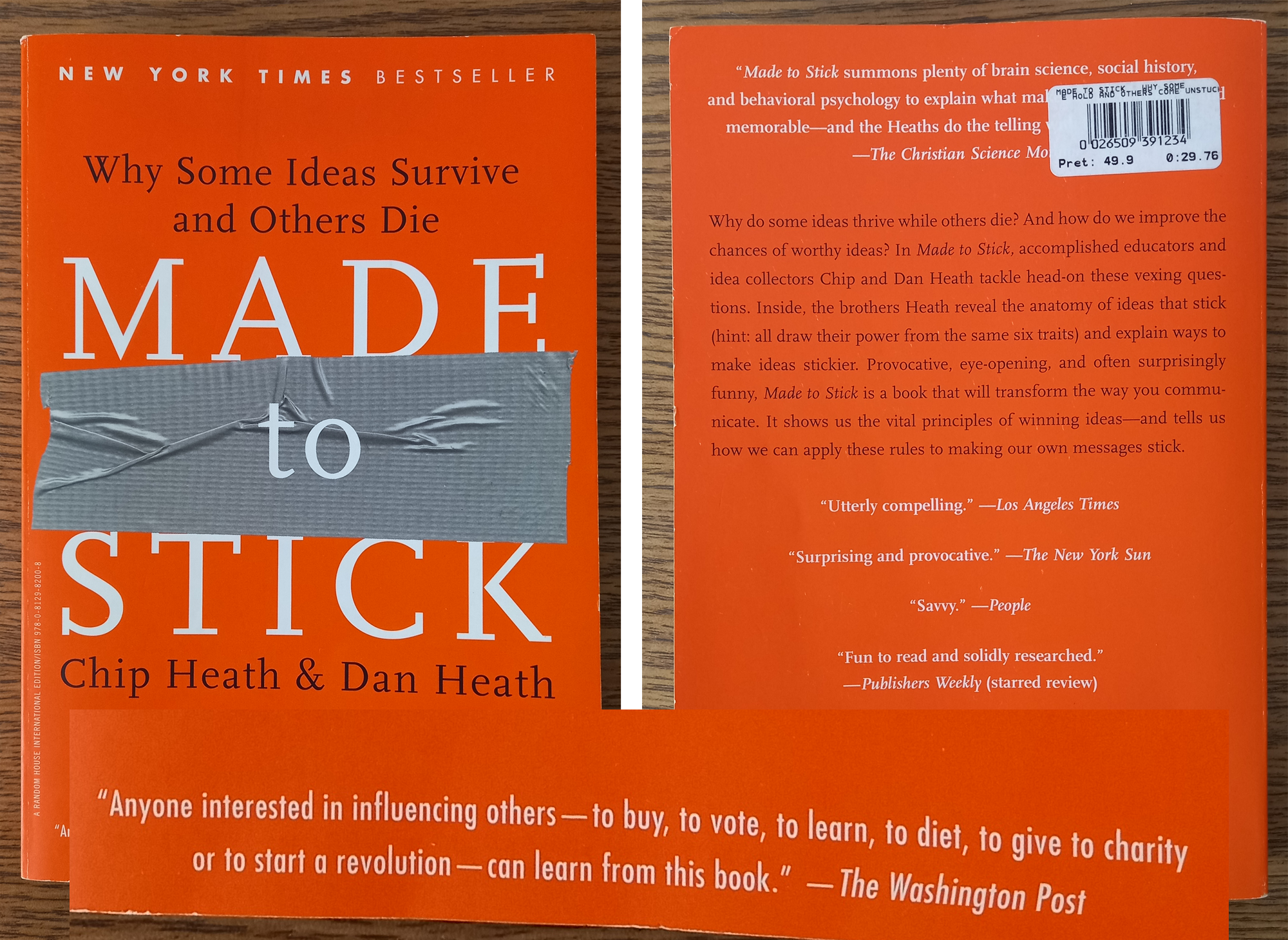
We live in an era where more and more people are learning how to influence others. And yet there is so much to learn when it comes to spotting ideas, creating a persuasive message, and changing people’s thoughts and behaviors. In Made to Stick. Why Some Ideas Survive and Others Die (2007), educators Chip and Dan Heath show us just how much.
Before you think this is some light book of popular psychology, let me tell you that Chip Heath has a PhD in psychology from Stanford and teaches organizational behavior at the Stanford Graduate School of Business, and Dan Heath is a former researcher with Harvard Business School and has worked with various think tanks.
Made to Stick was named Best Business Book of the Year and spent 24 months on the BusinessWeek bestseller list. I can see why. It’s well-researched, concisely and powerfully argued, and written in a pleasant casual style without relinquishing scientific thoroughness.
As expected, the authors build their theoretical framework about “sticky” ideas — which the authors define as ideas that are easy to grasp, memorable, and capable of influencing thought and behavior — by giving a slew of examples, including some experiments where it’s not easy to guess the outcomes, as is the case of some 2004 experiments outlining the “Mother Teresa effect” vs. the “drop in the bucket effect.”
In these experiments, participants predictably reacted better to appeals for a charitable contribution when they connected to the story of a single person — a seven-year-old girl from Mali named Rokia — than when they were simply given statistics about children going hungry in Malawi or Ethiopia. But then when they were given both types of appeals, participants gave much less than when they read about Rokia alone. The important takeaway from this line of experiments — which continued into a second round — is that when people think analytically — and it doesn’t have to be about the same topic; it could be the simple act of doing a little arithmetic — they respond less emotionally, even when they are given the emotional information.
These experiments and some other stories in Made to Stick read like classic examples, the kind you would find, for instance in Robert Cialdini’s Influence. The Psychology of Persuasion, but Made to Stick also has examples from business — from branding, marketing, and communicating business strategy — rather than from psychology and social psychology alone. There are also examples of packaging various ideas effectively in general, whether for ads meant to change public behavior or, as I mentioned, for business leaders to translate their brand message and strategy to employers and the public in a concrete, memorable way that is then easy to implement as part of brand management and brand communication.
Speaking of concrete, here’s a good example of a sticky presentation. But first, think about this for a few seconds: How would you communicate the fact that a bag of medium-sized butter popcorn has 37 grams of saturated fat?
You could tell people that USDA recommends a maximum of 20 grams per day and show two bars, one of them almost twice as tall as the other, but that is too abstract and rational.
In 1992, Art Silverman, who worked for a nonprofit organization called the Center for Science in the Public Interest, fought the Curse of Knowledge (you know what 37 grams of saturated fat means, but many people may not) in a press conference by verbally equating the above bag of popcorn to various greasy foods added up over the course of a day: a bacon-and-eggs breakfast, a Big Mac, fries, and a steak with all the garnishes. To make his message more memorable, he added a visual as well.
The message stuck because it was Simple, Unexpected, and Concrete. It also told a Story that was Emotional for many people struggling to be healthy. It was also Credible because it came from an authority on science and public health matters.
The qualities mentioned above (which spell the word SUCCESs) are the bases, or principles that Chip and Dan identified in what they call “sticky” ideas: ideas that are easy to understand and communicate, memorable, and conducive to changes in thought and behavior. Some ideas cover all the SUCCESs bases, while others only some of them.
Silverman’s idea stuck and it led to changes not only in moviegoers’ behaviors but also in the ways some of the movie popcorn was made from that point on (without coconut oil).
I mentioned the issues of communicating business strategy and the Curse of Knowledge. Here’s more about that. You may or may not be familiar with Trader Joe’s, a grocery chain that offers exotic foods at affordable prices. Here’s how they used to describe their target customer: “unemployed college professor who drives a very, very used Volvo.” That profile not only creates an image in the mind but makes it indelible as well by using the very evocative element of “a very, very used Volvo” instead of “a very, very used car.” Volvos are renowned for their quality and the fact that they last for a very long time.
Now, I admit I’m having a little trouble with this description, however, in that the concrete description doesn’t tell me much about the college professor’s interest in exotic foods.
But the image is, indeed, sticky. It’s Simple (it “finds the core” of the target customer), Unexpected (the professor is unemployed), and Concrete (more or less). It’s also Emotional in that we also get to care a little for this college professor who has gone through rigorous training to get a PhD and can only afford “a very, very used Volvo.”
Does it tell a Story too? It does, in a way. We can fill up the gaps but we do know that the professor has gotten a PhD and sticks with his old car from his college and graduate days as he looks for a new job — one he hopes to find soon, or else even his reliable Volvo may give up the ghost.
Is it Credible? Yes, because vivid details create internal credibility.
Speaking of credible ideas and vivid details, here’s another example: a man swallowing a glass with about a billion H. pylori bacteria to prove a scientific theory by giving himself an ulcer — and treating it.
This was Barry Marshall, a thirty-year-old gastroenterologist in training at the time. He had just completed his residency as an internist when he identified a bacterium, later known as Helicobacter pylori, or H. pylori, responsible for gastric and duodenal ulcers. The year was 1981, a time when fellow scientists of his didn’t believe a bacterium could cause an ulcer since the idea went against common sense (was Unexpected), as the acid in the stomach was believed to be too strong for a bacteria to survive and multiply and cause so much damage. Then, to counter their hypothesis, there was also the argument that while the vast majority of patients with stomach ulcers had H. pylori, there were also people with H. pylori who didn’t develop ulcers.
And then, as Chip and Dan Heath point out, doctor-in-training Barry Marshall and his peer J. Robin Warren, a pathologist, were from Perth, Australia, rather than from one of the centers of the scientific world. They were also rather young. It was not expected of them to solve the problem of stomach ulcers.
Barry Marshall became a bit like the American doctor and virologist Jonas Salk, who tried the polio vaccine on himself and his family in the fifties. At last resort, this was the most credible thing Marshall could do, given the state of acceptable scientific truths in the early 1980s and the context surrounding him and his research. He drank the bacteria, gave himself an ulcer, and cured himself with antibiotics and bismuth.
If he didn’t have enough authority (external credibility) to make himself believed, he acquired internal credibility by appealing to a vivid life story. And because his idea met other requirements for stickiness, it made history. It stuck. It was a SUCCESs (Simple, Unexpected, Concrete, Credible, Emotional, and it involved a Story).
What do these three ideas have in common, beyond the SUCCESs schema?
They bypass the Curse of Knowledge, by translating statistics (the popcorn story), turning scientific findings into a concrete example (the H. pylori story), and turning an abstract concept into a relatable, almost visual character (Trader Joe’s).
They also do many other things, not all of them spelled out as clearly in the book.
It’s believed, the authors say, that an ad should appeal to people’s self-interest, as in don’t show me what this product can do but show me what it can do for me. But it’s equally true, the Heath brothers say, that sometimes people respond better to ads that appeal to notions of group identity.
One example is the “Don’t mess with Texas” ad campaign, which reduced litter in Texas by a significant amount — by 29 percent! The campaign involved many Texan celebrities, from athletes to musicians, including Willie Nelson, but the ads didn’t ride on celebrity power but rather on the power of Texan-ness, something that was both tapped and molded during this campaign. The authors don’t spell out this last point, but, of course, it’s a terrain ripe with possibility (for better or worse). You can appeal to a group identity while (re)creating that identity through an ad campaign, a product, or a political message.
Another important point in the book is that a simple idea does not equal a sound bite, but rather a concise message with a core. The authors illustrate with a proverb: “A bird in the hand is worth two in the bush.” I guess the authors had to include proverbs in their book, because they’re pretty sticky, aren’t they? But they didn’t follow this thread by including catchy slogans. I would have welcomed some, such as “Finger lickin’ good” from KFC (Simple, Concrete, and Emotional).
Other notions to keep in mind with regard to sticky products are decision paralysis and predictability. Sometimes having fewer features is desirable (as on a remote) and less variety in a product leads to better sales, as was the case of Hamburger Helper in 2005, when a young new CEO initiated a study to better know their product users, visited mothers who cooked Hamburger Helper for their kids, and eventually decided to stick (pun intended) with a limited number of products, since mothers tended to choose certain flavors for their kids.
Of course, the “feature creep” mentioned by the authors with regard to the Palm Pilot designers, who resisted it, didn’t prevent smartphones from becoming what they are now: power-packed mini computers.
There’s more in the book about how the various qualities in SUCCESs can reinforce one another. For instance, in the case of Southwest Airlines, “THE low-fare airline,” one of its CEOs, Herb Kelleher, refused to offer chicken salad on certain flights, even if some customers had preferred it, because that would have gone against the brand’s key message, i.e. that they were “THE low-fare airline.”
The chicken salad element adds Story to the idea of Southwest Airlines in a way that also makes it Concrete as well and hones it closer to the core of the brand by Simplifying its core message, in a sense. It also brings something Unexpected into the equation, something that, as the authors say, at first appears to be common sense: customers would have liked that chicken salad — but not if it had raised the prices of the fares.
The Story also adds an Emotional element: we all want to have a good flight, and for many of us, the thought of tasty food, especially on an airplane, appeals to our emotions.
Finally, the Story is more memorable, stickier — and it makes the idea of “THE low-fare airline” stickier too, becomes it comes from an interview with Mr. Kelleher himself (it’s Credible), who stressed his airline’s core message and how committed Southwest was to it as a company — even though, again, there were voices who appealed to what, in a different context, in a brand with a different core, would have been common sense.
There are many other examples and a few more important concepts explored in the book, but to me these were some of the more resonant.
I encourage you to read the book.
Oh, before I finish this review, here’s another way the authors frame their SUCCESs schema or checklist:
Pay attention: UNEXPECTED
Understand and remember it: CONCRETE
Agree/Believe: CREDIBLE
Care: EMOTIONAL
Be able to act on it: STORY
It’s easy to see that this schema closely parallels the AIDA model from advertising: Attention, Interest, Desire, and Action.
Also, while the authors don’t point this out, it’s easy to see that these are not straightforward correspondences. You may remember something not only because it’s Concrete, but also because it’s Emotional and Unexpected.
You pay attention to something not only because it’s Unexpected but also because it resonates with you Emotionally; also, in many cases, because it’s Credible, and because it tells a Story.
And then the impact a story has also comes from its emotional core and its credibility, along with its concreteness and unexpectedness, as in the case of the H. pylori story. But it’s ultimately the Story element that, by bringing together all the other qualities, leads to a change in behavior.
Okay, I hope I’ve incited you to read this book. You’ll benefit from a plethora of research, see stories unfold, and get to weigh quite a few intriguing . . . well, ideas.
*
Thank you for reading! As always, pins and shares are much appreciated!
To a happier, healthier life,
Mira
 HappierHealthier.Blog