



This work by the British Japanese Nobel Prize winner is intriguing and puzzling. It made me think of Never Let Me Go, among other things. This review includes important spoilers.
A version of this article was originally posted on May 11 in Counter Arts on Medium.
I have to admit that it took me a while to read Klara and the Sun. It started with some very intriguing writing but then I couldn’t see the point of many short digressive passages. I knew, however, that it was part of Ishiguro’s style and that I needed to trust him, so that’s what I did.
The last third, very resonant and full of notions to chew on, more than rewarded my trust.
It was during this third part, too, that I started to notice the similarities in theme and treatment with a former book by Kazuo Ishiguro, Never Let Me Go.
If you’ve never read that book or seen the 2010 film with Keira Knightley, Carey Mulligan, and Andrew Garfield, the story in Never Let Me Go revolves around Kathy, Ruth, and Tommy, first teenagers and then young adults, and how they are trying to make the most of their lives, unaware of some large truth hovering above them.
The story starts with the three friends living at a boarding school, where they focus a lot on making art (drawings). In time, they learn that they are created as clones of people from the privileged classes and raised as organ donors for them.
Their roles in life revolve around these donations, with two options: to be either “carer” for donors for a while, and then donors themselves, or directly a donor, whereby they will become more and more incapacitated as they donate their organs up to three or four times, until they “complete” (die) during their twenties or thirties.
A touching thread in the story has to do with the teenagers’ art. It is there as an experiment, to see if the clones are truly human, but Tommy believes that one of their guardians at the boarding school, who creates a gallery for their art, does so because she wants to see who is in love. Then in time, the youngsters also come to believe a rumor that couples in love may be granted deferrals from donations. They aren’t.
The film is moving and the performances are stellar. The 2005 book is also impressive, and it led me to other titles by this author.
Kazuo Ishiguro, winner of the 2017 Nobel Prize for Literature, is not a straightforward writer. He veils the facts of his stories in several layers of allusive yet elusive language, and sometimes you get frustrated for a large part of his novels trying to understand what exactly he is talking about.
Never Let Me Go and Klara and the Sun — possibly also The Remains of the Day, but I never read it (I only saw the movie) — are more accessible than some of his other books, but even here, you’re drawn into the atmosphere of the novel before you figure out what exactly is taking place there.
For instance, in Klara and the Sun, when Josie and her mother come to shop for an AF (Artificial Friend), Josie’s mother asks her/the AF/Klara to walk like Josie. At first, it seems like something meant to test Klara’s observational powers, but later we realize it was much more than that.
To give you a short overview of the plot, the story starts with Klara and other AFs waiting in the window of a store and talking about what they see out the window. The Manager interacts with them as well. Then Josie walks down the street and spots Klara, eventually returning with her mother to buy her.
Klara spends time with Josie, who has bouts of ill health, and also with her boyfriend Rick, who is a little lost because he hasn’t been “lifted” (later we learn what that means), and begins to care for both.
Then Klara starts believing that if she destroyed a polluting construction machine, Josie, who has an undefined illness that comes and goes, will get better. She also talks to the Sun, asking him to make Josie better.
There is also a plot twist I didn’t see coming, where Klara’s mother talks to someone to create a machine resembling Josie using Klara’s data on Josie. Klara doesn’t mind being changed into something else but she believes she can save Josie with the help of the Sun — and she does.
The story is narrated by Klara herself, who speaks a stilted language, very much expressive of android artificiality. However, interestingly, the human characters don’t sound hundred-percent human either. They also interact with Klara in a way that acknowledges her almost-human status.
It’s all far-fetched, but there are some connected elements that make sense as a whole. At the beginning, for instance, we gather from Klara that she is powered by the sun, so it makes some sense for her to see the sun as a source of power. Yet when she talks to the Sun, she makes a leap toward faith or superstition.
Sure, it’s based on one of her observations, that of a homeless person on whom the Sun’s rays had fallen for a while, allowing him to get up and leave — and get healthier; but then when she talks to the Sun she introduces other elements into the story: Josie and her boyfriend Rick truly love each other, so they deserve to be able to live and enjoy each other. And then when Rick and Josie split ways, Klara worries that the Sun may think that she had deceived him.
So the question is, does she anthropomorphize the Sun? Is that what’s happening? Doesn’t she see that the Sun is a completely different thing than human beings?
It made me think of Spielberg’s movie AI Artificial Intelligence, on which I wrote an extensive piece. In that movie, David believes in the Blue Fairy, and his belief is even bigger than Klara’s, because David thinks the Blue Fairy has the power to change him from an advanced “mecha” (android) into a “real boy.”
Spielberg’s conceit is, in general, much stronger than Ishiguro’s; because David gets the ability to love his adoptive mother, and he expresses his love and emotions much like a little boy would.
Ishiguro, too, suggests that Klara loves Josie, and that she would be willing to give up her mechanical life for her. She does, in fact, give up some fluid from her body in order to destroy that polluting construction machine that blocks out the sun. This leaves her a little impaired, but she doesn’t mind.
Where and how does Klara get this impulse for self-sacrifice and faith/superstition, not to mention emotions and love, to start with? How can these things be programmed?
I gobbled up all of Spielberg’s AI movie because it was mostly a parable, but I don’t really know what to do with these questions within the realm of Ishiguro’s book.
It seems to me that Ishiguro was riffing on his own Never Let Me Go when he wrote Klara and the Sun. The similarities are striking. Klara is primed to be a replacement for Josie, much like Kathy, Ruth, and Tommy are raised to be organ donors.
Then Klara, much like those youngsters, does not rebel against her possible sacrifice.
Kathy, Ruth, and Tommy, while being treated as less-than-human, show all the range of human emotions, albeit on a flatter note. They are no less humans for being clones, and yet their lives are stripped of dignity.
Klara, too, becomes very human-like in her emotions, and yet when Josie gets well, she is practically discarded. Toward the end of the solar-charging batteries she is relegated to a closet and then to a field.
Klara’s focus on the love between Josie and Rick also reminded me, tangentially, of Never Let Me Go, because Klara believes they should both be saved since they’re young and in love, much like Kathy and Tommy are led to believe that there may be a chance for Tommy to get a “deferral” from his fourth donation because they truly love each other.
From what I remember, however, the question of God doesn’t appear in Never Let Me Go. Maybe Ishiguro felt he could address it here, with Klara.
He also touches on many other issues related to a future populated with both humans and androids. The children do not go to school and instead use a device called an “oblong.” They also learn to socialize by participating in very strained get-togethers. Some of them get attached to their Artificial Friends, while others ridicule AFs.
Another important thread in the book is about being “lifted” or not. Some kids get to be enhanced through gene editing, which, as Josie’s situation shows, comes with some risks. At least this is how I read part of the novel. According to what Ishiguro says in an NPR interview, gene editing in the novel is supposed to help protect people from disease as well, not just ensure that they will be able to access better positions in society. From a dialogue in the book, however, I gathered that Josie’s mother was reckoning with both guilt and righteousness about Josie’s getting ill after being “lifted.”
But back to Klara and her Sun, according to that interview with Kazuo Ishiguro, Klara’s belief in the Sun does, indeed, comes from her own knowledge that she’s solar-powered as well as from observing that good things happen when the sun shines on people. Yet Ishiguro says Klara simply thinks the Sun is a person.
I figure now that maybe Klara thinks the Sun is a person from far, far away; but people don’t shine golden rays like that, so where does Klara get the sense that the Sun is a person? Does she think that the Sun created her as well? In the NPR interview I read, Ishiguro doesn’t address that. In his view, Klara simply becomes more and more human-like.
But how, how does it happen? Again, I didn’t ask these questions in Spielberg’s movie AI but here I feel they are warranted.
Yet I’m coming up empty. I could say, for instance, that the scientists who created Klara had figured out the mystery of the human soul. Say they figured that everything is predictable and all can be known. However, the author himself goes against such notions when he says that the human heart is like a house with many rooms, a house where each room contains other rooms, and so on ad infinitum.
It’s true that Klara says that an AF should be able to explore all those rooms, but Ishiguro himself says that Klara is like a pure, naïve child, so he probably doesn’t concur with her on this matter.
Or maybe his belief is somewhere in between: maybe he thinks an AF could approximate that knowledge of a human heart to a great degree. After all, despite all her naivety, Klara did latch onto something important: the sun gives sustenance; the sun can help humans get healthier.
As for Klara becoming more and more human-like, it may be that just as we’ll learn to speak and act more like machines to suit the machines among us, the machines themselves will copy us and become ever more human-like.
So anyway, there you have it: an interesting literary character, intriguing writing, and another creative take on the issue of artificial intelligence.
If you’ve read this book, I’d love to hear your thoughts.
Disclosure: This blog post contains some affiliate links. If you click on (any of) them and make a purchase, they generate revenue for this blog (at no extra cost to you!). I am a Zazzle Associate and designer, and I earn commissions when you buy products through my referral links. All affiliate links on this blog are identified as such. Here’s my Full Disclosure.

(affiliate image link)

(affiliate image link)

with a collage of photos of bookshelves (affiliate image link)
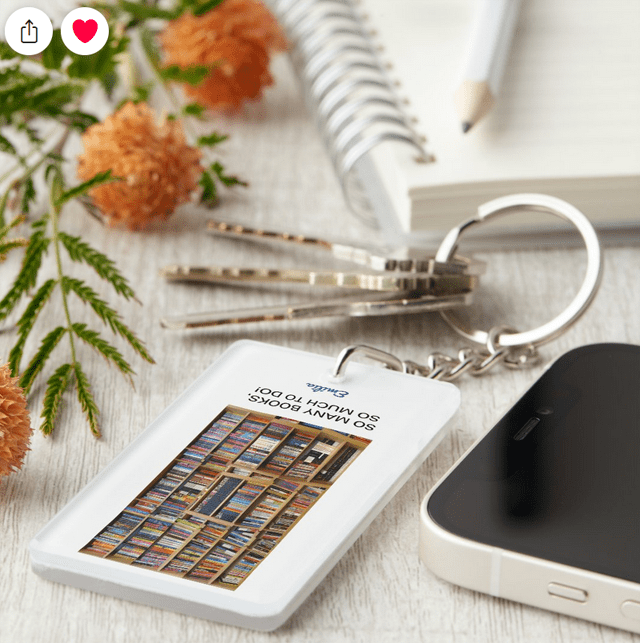
and a collage of photos of bookshelves (affiliate image link)
I hope you’ve enjoyed this post. As always, pins and shares are much appreciated! Thank you!
To a happier, healthier life,
🙂 Mira
 HappierHealthier.Blog