


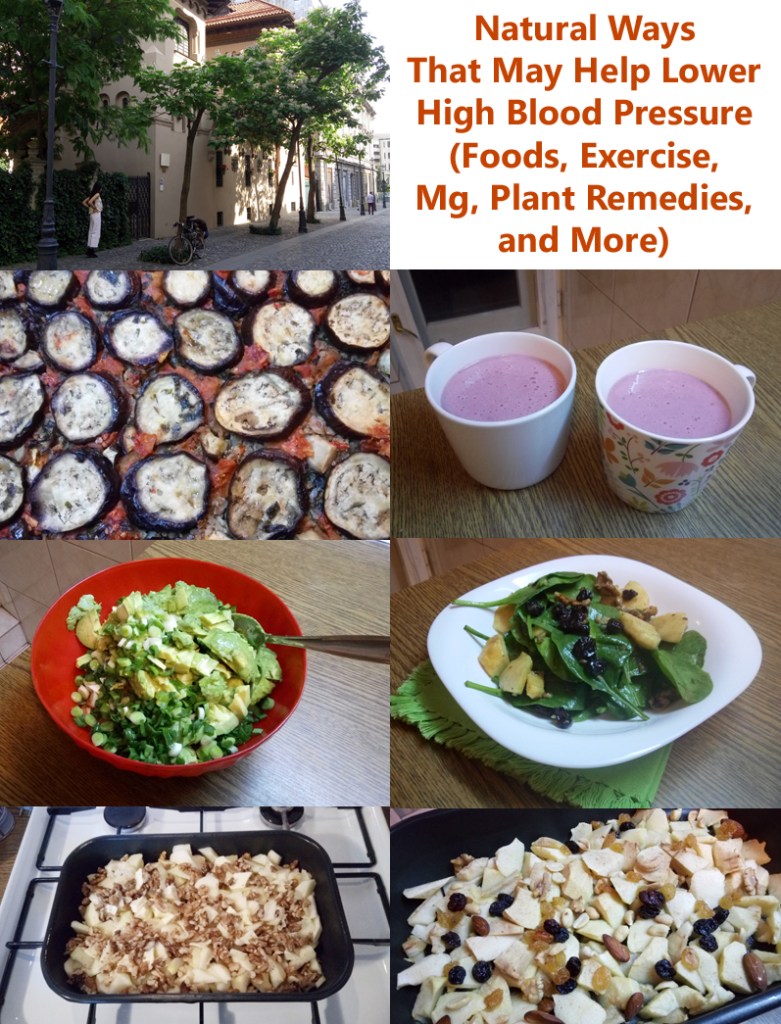
(Photos and collage © Mira)
This post is about natural ways—foods, remedies, and lifestyle changes—that may help lower hypertension. Please note that the information contained on this page is aimed at people with elevated (prehypertension) and stage 1 high blood pressure. The American Heart Association gives the following value ranges for the above conditions: 120–129 systolic pressure and less than 80 diastolic pressure for prehypertension, and 130–139 systolic pressure or 80–89 diastolic pressure for stage 1 hypertension.
I’ve been interested in how to best prevent and battle high blood pressure for a while now, and then that battle became very personal. Now that I take my blood pressure regularly after having some scares (a systolic BP of 105), I’ve noticed that it can spike from 120/85 or 125/87 to 130/95 or 135/97 in tense situations. And then after I relax from certain stressors I go back to 125/87, which is why I’ll start this piece by advising you to try to practicing meditation, or at least deep breathing: in through your nose, out through your mouth, four long breaths in, four long breaths out, from your belly, preferably with a hand on your chest and one on your belly (to better notice how your belly expands and contracts). (Also, take your blood pressure several times a day for longer than just a few days, so as to better record if your hypertension is temporary or pretty much stuck at higher levels. In the letter case, seek medical help immediately and discuss with your doctor where to go from there if you also want to try natural remedies.)
It’s also useful to practice the progressive muscle relaxation technique. Lie down on a yoga mat or on your bed and focus progressively on groups of muscles from your feet to the top of your head. Just breathe in and out the way I describe above while you contract each group of muscles on the in-breaths and relax them on the out-breaths.
Disclaimer: I am not a medical or health practitioner, and no part of This Blog, or the websites and products I mention and link to on This Blog, is intended as professional medical or health advice, and should not be considered as such. Consult with your doctor(s) about starting any course of treatment, taking any supplements, or changing any (dietary, exercise, etc.) routines. Note that natural supplements and even some foods may interfere with certain medications. Here are my Full Terms and Conditions.
Disclosure: This blog post contains some affiliate links. If you click on them and make purchases, they generate revenue for this blog at no additional cost to you. I am a Zazzle Associate and designer, and I earn commissions when you buy products through my referral links. All affiliate links on this blog are identified as such. Here’s my Full Disclosure.
- So, Deep Breathing is one technique for helping to lower blood pressure.
- Weight Loss is also at the top.
According to an article on WebMD, if you lose 20 pounds, you may be able to drop 5–20 points off your systolic blood pressure (the top number).
- Limit as much as possible your intake of saturated fats and try eating Healthy Fats and Many Vegetables.
Vegetables are always a good idea, including for high blood pressure. But there are also various other foods that help with hypertension. Here’s a rundown of thirty foods that help lower high blood pressure naturally: almonds, avocados, bananas, beets, blueberries, broccoli, dark chocolate, Ceylon cinnamon, egg whites, low-fat dairy, garlic, ginger, grapes, hibiscus tea, kiwis, lentils, lettuce, oatmeal, oranges, peas, cayenne pepper, baked potatoes; pumpkin, sesame, and sunflower seeds; salmon, soy foods, spinach, tuna, watermelon.
I have created a visual design of these foods, as a reminder, on many products, from postcards and mousepads to magnets and mugs, and more. Here are two popular mugs to help you stay mindful of important foods to include in your meals.

(affiliate image link)

(affiliate image link)
In terms of healthy fats, I try to eat daily (or almost daily), if possible, at least a salad with olive oil, about half an avocado, several nuts and/or about two teaspoons of ground seeds (especially pumpkin, sesame, and sunflower, but also others such as flaxseed), and, at least twice a week, fish rich in omega-3 fatty acids (salmon, mackerel, sardines, among others). Failing that, an omega-3 supplement also helps.
- Exercise More
Apparently even half an hour a day can make quite a difference, reducing up to 4–5 points from your systolic number, according to the WebMD article referenced above. I personally find half an hour of daily exercise too little to make such a positive difference in one’s blood pressure, but on the other hand, I can see why not making this effort could raise your BP levels!
Please check with your doctor(s) to determine the kinds of exercise that are right for you, and how often and how long you should engage in exercise.
- Less Salt and Alcohol
I don’t drink alcohol, except, well, very little a few times a year at special occasions, but I do like salt in my food. I also use a lot of spices, though, and spices are known to limit the necessity of adding too much salt.
Here are some spices to use as salt substitutes: lemon or lime juice (it works wonders in my Thai soups), garlic, black pepper, chili powder, cilantro, lemongrass, and paprika. Talk to your doctor(s) and have fun replacing some of the salt in your food with these healthy, yummy alternatives.
- Magnesium, Hawthorn, and Hibiscus
Magnesium helps with physical and mental stress, and it also helps with blood pressure, doing a better job if you haven’t fully developed hypertension and only have elevated or stage 1 high blood pressure. It actually has many benefits, which is why it’s often recommended as a daily supplement. Mg helps with many health issues, including depression and insulin resistance, and it reduces inflammation in the body–among other things. It’s also a mild laxative.
There are, however, some potentially serious risks with large doses of Mg intake, so don’t overdo it. According to a WebMD article, women between 19 and 30 years old should aim for 310 mg/day, and women past 31 years old for 320 mg; men between 19 and 30 y.o. should have 400 mg/day, and men past 31 y.o. about 420 mg/day. Do note that some medications (here are a few of them) interfere with magnesium absorption, causing its loss.
Please check with your doctor(s) to determine your magnesium needs.
Hawthorn is a popular remedy for everything heart-related here in Romania.
Several species in the genus Crataegus have been studied for their health benefits. They can help with high blood pressure and the elasticity of blood vessels, cholesterol and triglycerides, chronic inflammation, and more.
Traditionally in Europe only the berries were used, but these days studies show that the leaves and flowers can be helpful too. My aunt, for instance, who was diagnosed with various heart ailments some twenty years ago, among them extrasystoles and cardiac neurosis, has been taking hawthorn regularly — first teas made from dried berries, and then, when she learned how to make them, tinctures made from fresh leaves and flowers. Her heart problems, however, had gotten worse with time, which is why I think she should have gotten a conventional medical treatment.
Other people I know take hawthorn and medicine, but beware of interactions with heart medications and other drugs! Hawthorn may interfere with Lanoxin/digoxin, Beta blockers, and meds for high blood pressure, sexual dysfunction, or anything with nitroglycerin. Please check with your doctor(s) to see whether it is safe for you to start taking hawthorn supplements. Also note that hawthorn has blood-thinning properties, so check with your doctor about when to stop taking it before surgery and when to resume it after surgery.
A species of hibiscus, Hibiscus sabdariffa a.k.a. roselle, is also a popular and effective natural remedy for elevated or stage 1 high blood pressure in many countries. There are several studies documenting this (here’s one from 2019). They recommend drinking two or three cups of hibiscus tea a day while you also adapt your lifestyle and eating regimen. I use hibiscus in my teas on a daily basis, mixing it with other herbs. My mother does too, and she has no high BP even though she’s in her seventies now.
And I know of someone else in his seventies who, at the time of our meeting, had been drinking one liter of hibiscus tea a day for years — making it only with the sepals of the hibiscus flower — to help keep his blood pressure in check. (He was able to do just that.)
Hibiscus packs lots of antioxidants and it can have beneficial effects on your blood sugar, triglycerides, and total and LDL cholesterol levels, but it can also interfere with some medications, including some for high blood pressure and diabetes. At the same time, it may or may not be toxic: scientists are undecided whether roselle increases our body’s absorption of aluminum of not, so it’s probably a good idea to err on the side of caution. Please check with your doctor(s) to see whether it is safe for you to use roselle.
- Make sure you Sleep Enough.
If your sleep suffers, or you don’t get enough sleep, that bodes badly for your blood pressure. To improve your sleep quality, it’s also important that you go to bed around the same time each evening, and that you also wake up at a more or less set time.
I hope this post helps you some. If you’ve found other natural remedies for high blood pressure that work for you, please do share!
To a happier, healthier life,
Mira
P.S. I’d appreciate a pin/share if you found my post helpful. Thank you! 🙂
 HappierHealthier.Blog
3 Comments